
Electrostatics in Injection Molding
No more sticking parts and dust – Maximum OEE through controlled discharge.
We eliminate electrostatic disturbances in plastics processing. With Bonato’s intelligent 24V DC technology, you ensure stable cycle times, reduce rejects, and protect your electronics.
The Physics of Interfaces: More than just “Electricity”
The Triboelectric Effect in Detail
In the cavity, two worlds meet: the highly viscous plastic melt and the metallic mold surface. During the separation process (demolding), charge transfer occurs at an atomic level. Since polymers are extremely poor electrical conductors, this charge remains locally bound.
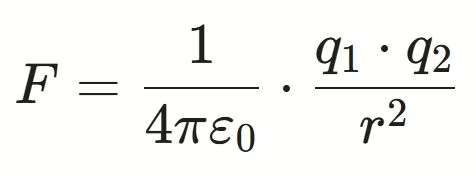
The resulting field strength can exceed the dielectric strength of air, leading to uncontrolled spark discharges. We precisely calculate the force according to Coulomb’s Law:
The Triboelectric Series of Polymers
Not every plastic reacts the same way. Our systems take into account the specific charging potential:
Application Focus: Where We Make the Difference
A. High-Speed Demolding (Cycle Time Killer)
Components stick to the mold or gripper. Our solution: The ultra-compact IDB-7 bar. Its design allows it to be integrated directly into the gripper of the removal robot or mounted immediately at the parting line.
B. In-Mould-Labeling (IML) & Decoration
Controlled point charging with EASY CHARGE, which fixes labels without adhesive. We generate a controlled point charge that securely fixes the label without adhesive before the melt injects.
You are currently viewing a placeholder content from YouTube. To access the actual content, click the button below. Please note that doing so will share data with third-party providers.
More InformationC. Cleanroom & Medical Technology
Particle-free discharge without disruptive air turbulence using IDB-11 systems. These operate without fan motors, cause no turbulence, and meet the highest requirements for particle-free products such as syringe bodies or optical lenses.
Economic Calculation: Why Antistatic is Not a Cost Factor
An amortization calculation for a standard injection molding machine (20s cycle, 3-shift operation):
- Problem: 2% rejects due to dust and 1s delay in demolding.
- Annual loss: approx. €12,500 (material + machine hourly rate).
- Bonato System Investment: approx. €2,800.
- ROI (Return on Investment): In less than 3 months.
Technical Guide: Industry 4.0 Integration
Unlike old AC systems, Bonato 24V DC systems are fully diagnostic:
- PLC connection: Monitoring of operating states directly in the machine control via RS485 or digital I/Os.
- Contamination alarm: The system automatically reports when the emitter tips are contaminated by polymer vapors.
- Remote control: Adjustment of the ion balance (pulse-pause ratio) via digital inputs to react to batch changes (e.g., new material vs. regrind).
Technical Glossary
Ionization: Process by which air molecules are split to create conductive ions.
Emitter: The high-precision tungsten tips where the corona discharge takes place.
OEE: Overall Equipment Effectiveness – the measure of your productivity.
ESD: Electrostatic Discharge – the danger for sensitive electronic inserts.
Cavity: The hollow-forming part of the mold.
Expert FAQ: The Knowledge Base for Injection Molders
Each Bonato system features a status LED (Green/Yellow/Red) directly on the bar. Additionally, the “Clean Check” output can be reported to the PLC, stopping the machine before scrap is produced.
Our 24V electronics are shielded to the highest EMC standards. Even with direct mounting on high-speed robots (Fanuc, Kuka, Wittmann), no interference occurs with the sensors or servo motors.
Yes, we offer special EX-certified bars for environments where flammable gases or dusts are present, to prevent ignition sparks caused by static discharges
Our 24V electronics are shielded to the highest EMC standards. Even with direct mounting on high-speed robots (Fanuc, Kuka, Wittmann), no interference occurs with the sensors or servo motors.
Under normal load and with regular cleaning, the emitters last for several years. Should they corrode due to aggressive outgassing, Bonato is one of the few manufacturers to offer easily replaceable emitter kits.
Blowers cause air turbulence, which is counterproductive in cleanrooms or with delicate parts. An ionizing bar like the IDB-7 works “silently” and precisely where the charge occurs – without stirring up dust.
Recycled materials often have an inhomogeneous charge structure due to residual contamination or additive residues. This is where our controllable systems excel: By adjusting the balance between positive and negative ions, we can guarantee a stable process even when material quality fluctuates.
Answer: No. Ionization only affects the electrical charge balance on the surface. The chemical structure, mechanical strength, or melt viscosity remain completely unaffected.
AC systems operate with a fixed mains frequency (50Hz). Bonato’s DC systems allow for variable pulsing of ion emission. This means: Higher ion density, greater range, and absolute safety, as no dangerous high-voltage cables need to be routed through the machine.